• Skip to main content

Karan Chadda

Digital experience, marketing analytics, and AI

  • Home
  • Writing
  • Explorations
    • Web apps
    • GPTs
    • Fake news memes
    • Poetry by numbers (2015)
    • Social media best practice
  • About me

January 24, 2017

LinkedIn: building a social CRM?

Image: Nan Palmero (flickr)

LinkedIn has been part of Microsoft for a few weeks now. As you’d expect from a firm with new owners, there’s been a steady stream of news it seeks to turn change into momentum. So what are they building?

A new wardrobe

The most immediate changes are cosmetic. LinkedIn has long had a reputation for being startlingly clunky network. A series of cosmetic changes, which began to rollout before the deal was complete, have updated its appearance and tweaked some of the structure; profile pages are easier to access, as are company pages for page managers. Navigating LinkedIn is still testing at the best of times, however, so expect more changes to come.

I’m not looking for a job

LinkeIn’s last reported revenue ($960million) showed a year-on-year increase of 23%. It’s impressive growth, but almost two-thirds came from its talent solutions offering.

We all have anecdotal evidence that people only really begin engaging with LinkedIn when they’re looking for a job. Be honest, when was the last time you brushed up your profile? LinkedIn needs to breakaway from its reliance on its talent solutions income.

Social CRM

It looks like one part of the solution is CRM. Microsoft has an established CRM tool, Dynamics, but it’s clunky, focused solely on the enterprise (where the money is) and unloved by anyone who uses it. LinkedIn has the potential to become a strong mobile CRM. Last week, through a calendar integration, they enabled mobile app users to see the LinkedIn profiles and updates of people they have meetings with.

This is a really simple but key integration. Better, more current information about the connections you’re actually dealing with, rather than the ability to spam people you’ve never met might be something more people are willing to pay for. And getting people to pay is critical if LinkedIn is address its financial dependency and the reputation limitations of its recruitment solutions. In its last quarterly results, LinkedIn said less than a quarter of its users visit the site at least monthly. It doesn’t, however, break out how many of those regular users pay for premium accounts. It’s likely to be a small fraction.

The calendar integration is a simple first step. Integrating with email services and other social media (where possible) could see LinkedIn become a very powerful, incredibly simple social CRM that sits in your pocket. It could become a hub that helps you manage relationships.

Header image by Nan Palmero

November 7, 2016

Mobile-first and AMP developments at Google

search

Google has moved its search results to mobile-first indexing. It’s a logical progression in the development of search when you consider the increasing dominance of mobile search.

Earlier this year, Google announced that searches on mobile devices overtook searches from desktops. Desktops, with their falling sales, will never catch up. However, until now Google’s search algorithms have indexed the web and delivered results based on the desktop version of a website. This has led to mobile users being sent to sites that are not easy to on their devices. With its latest update, the search giant has fixed that.

Search results from Google are now based on the mobile version of a website. If your website isn’t mobile friendly, then you’re dropping further down the rankings. If you have a mobile version of your site but it is a pared back replica of your desktop site, you might need to look at whether it’s now a hindrance.

Already mobile? Time to AMP it up!

For those who have mobile-friendly sites, it’s time to think about AMP – accelerated mobile pages.

Early in the autumn, Google announced that it would be ramping up its AMP programme in the coming weeks. Quoting research that found that 40% of mobile web users abandon a website if it takes more than three seconds to load, they have worked on AMP, an open source initiative to improve the mobile web experience.

Google has promised ‘expanded exposure’ across it mobile search results for those who use AMP.

What to do?

If you’re not sure if your site is mobile-friendly, use this tool to find out. If it isn’t start looking into its replacement. Even a small consulting firm will find that between 15% and 25% of its web traffic is from mobile devices now.

Does your website need AMP? Unless you’re a publisher, it’s not likely at the moment. However, the mobile web is now dominant, so you should be keeping an eye on the growth of AMP.

September 12, 2016

FuturePRoof: Edition Two

FuturePRoof: Edition Two

PR as a management discipline

Last week, the second edition of FutureProof was launched at an excellent event hosted by the PRCA. Edited by Sarah Hall, the book contains 39 chapters written by leading communicators. It includes a chapter I wrote on CSR.

The book instantly became an Amazon bestseller within its category. You can download the Kindle version here. You can buy a printed edition here.

If you want to learn more about FuturePRoof, Stephen Waddington has written an excellent post titled ‘A story of two books about public relations – separated ‘by 25 years’. As has Paul Sutton, who describes it as, “call to arms for the PR industry.” Meanwhile you can listen to interviews with some of the authors on the C-Suite Podcast, whose team came down for the launch and spoke to some of the authors.

September 8, 2016

London Design Biennale

A great, international exhibition

Somerset House is currently hosting the first London Design Biennale. Artists from all over the world have contributed work exploring the theme of Utopia by Design. The exhibition fits into Somerset House’s broader theme for 2016: Utopia (this year is the 500th anniversary of the publication of Thomas More’s Utopia).

Thirty-seven nations, spanning six continents have contributed. Their work is varied and thought provoking. Exhibits look at everything from accessible design, visualised data and interactive installations that respond to movement and breathing.

‘Stump of Water’ is a delight.

I was particularly struck by Japan’s contribution. Artist Yasuhiro Suzuki’s installation has great variety. Pieces draw you in, encourage interaction and surprise. Titled ‘A Journey Around the Neighbourhood Globe’ the work looks at the world from various perspectives. The pieces dealing with time and globes are particularly appealing. The piece titled ‘Stump of Water’ is a delight, deeply thoughtful yet with a lightness and joy which is sometimes lacking in conceptual work.

It’s likely that the most talked about work will be Turkey’s ‘The Wish Machine’. A wonderful installation using plastic tubing that runs throughout the West Wing of Somerset House. People write wishes and place them in containers which are fed into the tubes. The wishes are pneumatically sent through the pipework and deposited into the unknown. The work is bold, easy to engage with and had people queuing up to get involved.

I recommend sitting in a corner and watching as others play.

Austria’s ‘LeveL’ is another exceptional work. Essentially a massive mobile, the work responds to movement in the air, just breathing on one of its light pods will see its glow diminish. It is a strong piece of work, that wills you to rush toward it and yet to fully get perspective on it I recommend sitting in a corner and watching as others play.

The London Design Biennale was fun and a great chance to see the work of artists from across the world. It’s on at Somerset House until 27 September. I thoroughly recommend checking it out.

Find out more about it here.

July 8, 2016

#LondonIsOpen

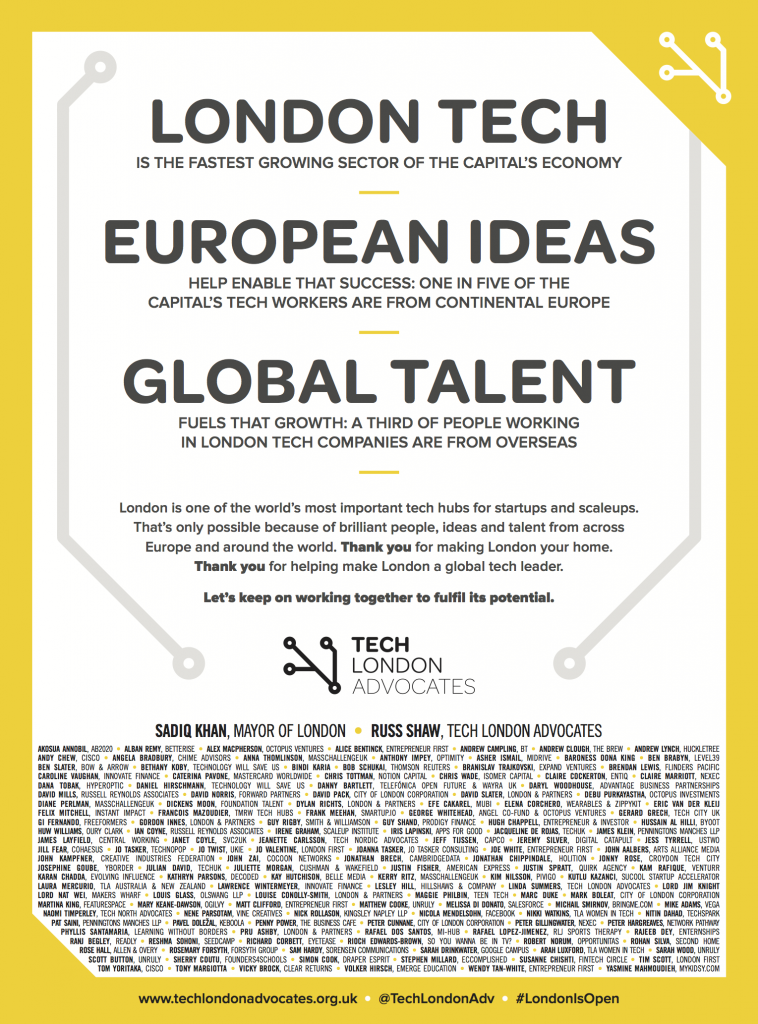
One week after the result of the EU Referendum, Tech London Advocates sent a message of unity to the tech community thanking Europeans based in London for their contribution to the industry’s growth. Signed by over 150 Advocates, including the Mayor of London, the advert championed European ideas and global talent as the driving forces behind London tech.

tla-city-am

  • « Go to Previous Page
  • Page 1
  • Interim pages omitted …
  • Page 16
  • Page 17
  • Page 18
  • Page 19
  • Page 20
  • Interim pages omitted …
  • Page 41
  • Go to Next Page »

Copyright © 2026 Karan Chadda | Views are my own